The carry-on arithmetic
What actually fits in a carry-on, counted in garments rather than promised in percentages: cube sizes, a day-count table, the liquids rule, and the three things cubes will not do.
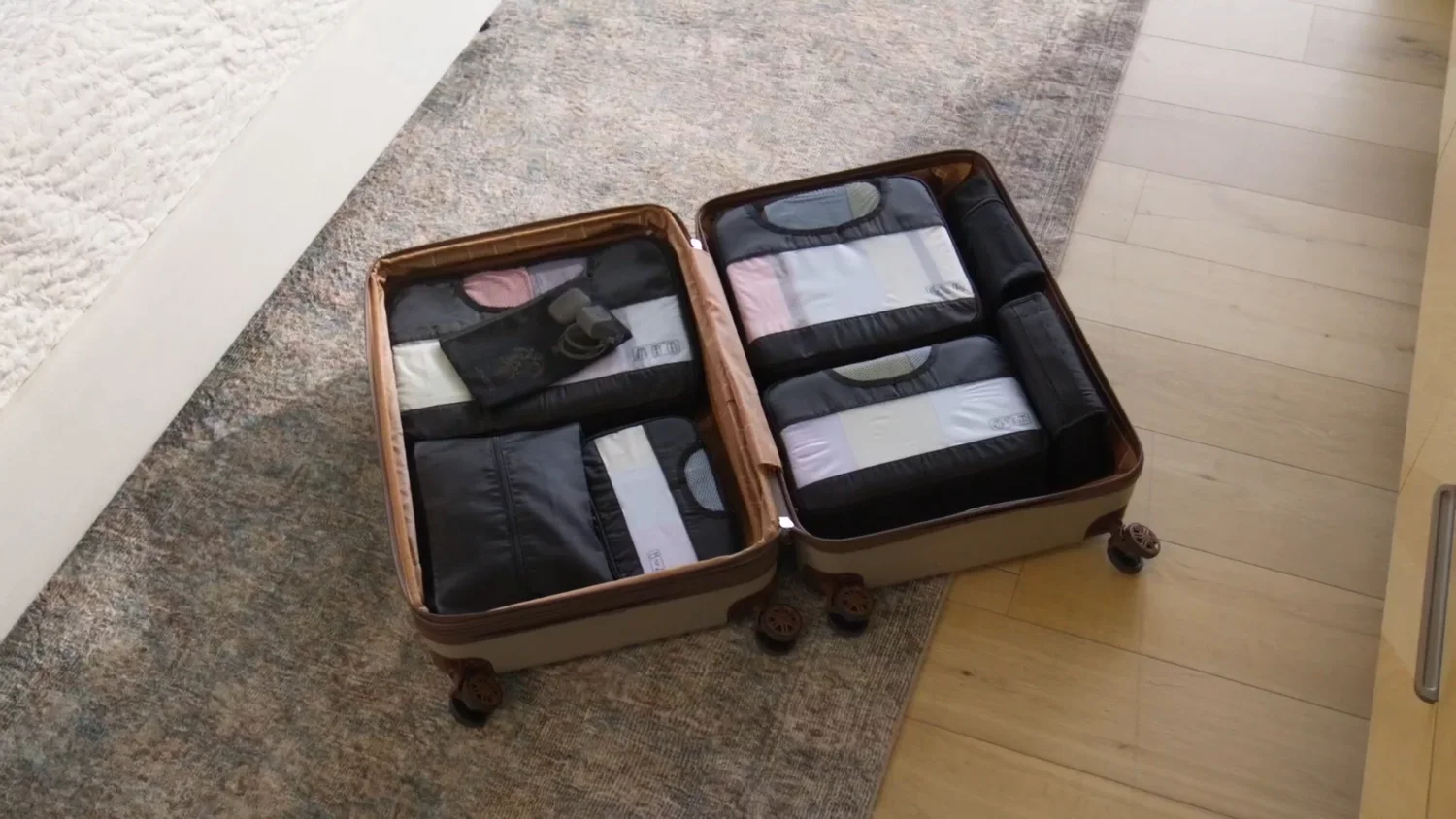
Why bags fill up before you leave the bedroom
Most overpacking happens long before your suitcase touches a scale or an overhead bin. It happens on the bedroom floor, usually two nights before a flight, when you pack for hypothetical versions of yourself instead of the calendar in front of you.
When you pack by mood, you pack for every possible emotional state, sudden weather shift, and social scenario you can imagine. You pack the shoes you have not worn in six months because you might feel like wearing them in a different city. You pack three extra shirts because you cannot predict which color you will prefer on Saturday morning. You pack an extra jacket in case an indoor venue is chilly, and another pair of pants in case you spill coffee on the first two.
This habit exists because an empty suitcase offers no natural feedback. A standard carry-on suitcase is a deep, open cavern with around forty liters of undivided air. When you lay a pair of jeans flat in the bottom of a suitcase, the jeans take up floor space, but they leave twenty inches of empty vertical air above them. When you toss a sweater into an open suitcase, the knit spreads out loosely, creating the optical illusion that the bag is half empty.
You see that open space, and your brain treats it as an invitation to fill it. You slide in two more t-shirts, another pair of socks, a spare sweater, and an extra pair of shoes. By the time you zip the lid closed, you have packed twelve days of clothing for a four-day trip. You have also compressed the loose clothing into an unorganized mass. The moment you open the suitcase at your destination to find clean socks, the entire structure collapses.
Packing cubes change this dynamic by removing the open cavern. A cube is not just a zippered pouch. It is a rigid volumetric boundary. When you separate your clothing into defined containers, you stop treating the suitcase as an infinite open bin and start treating your luggage space as a fixed numerical budget.
Volume as a budget
A financial budget works because you assign every dollar a job before you spend it. If you have five hundred dollars for groceries, you cannot spend six hundred dollars without borrowing from rent or savings.
Packing with cubes applies the exact same logic to your luggage. Instead of asking how many shirts will fit into the vast interior of a suitcase, you ask a much simpler question: what fits inside the single cube assigned to shirts?
Once you assign a specific cube to a specific category of clothing, the cube sets the limit. If your medium cube holds six folded t-shirts, your t-shirt budget for the trip is six. If you want to bring a seventh t-shirt, you cannot simply shove it into a random corner of the suitcase. You must remove one of the six shirts already in the cube, or you must decide to downsize something in another cube.
This single mechanical constraint stops overpacking before it starts. It shifts your focus from the total capacity of the suitcase to the individual capacity of each garment class.
The process creates three distinct advantages:
- Category isolation. Pants stay with pants. Socks stay with socks. You never need to dig through clean undergarments to pull out a sweater.
- Fixed compression. The cube holds the garments under consistent tension. Clothes do not slide, unfold, or bunch up in transit.
- Visual inventory. When you open a cube, you see exactly what you brought. When a cube is empty, you know that category of clothing is in the laundry pile.
Across our travel collection, our sets run from 4 to 11 pieces across four standardized sizes, alongside dedicated duffels and toiletry bags. Understanding what fits naturally into each of those four sizes is the first step in setting up your travel arithmetic.
The four cube sizes and what belongs in each
Packing cubes work best when garments match the surface area of the container. If you place a small item in an oversized cube, it slides around and wrinkles. If you force an oversized winter coat into a small cube, the seams stretch and the cube bulges into an awkward ball that wastes suitcase space.
Here is how clothing naturally maps across the four core sizes.
Extra large cubes
An extra large cube covers the full width and length of a standard carry-on interior. It is designed for your bulkiest garments, items that require broad, flat folds to avoid severe creasing.
Natural contents:
- Heavy knit wool sweaters
- Outerwear, light jackets, and fleece pullovers
- Two to three pairs of heavy denim or structured trousers
- Full-length dresses made from heavier fabrics
When packing an extra large cube, place the heaviest items at the bottom. Fold garments to match the full rectangular footprint of the cube so the surface remains flat from edge to edge.
Large cubes
A large cube occupies roughly half the footprint of a carry-on suitcase, or the full width of a standard duffel bag. This is the workhorse size for general apparel.
Natural contents:
- Four to six casual button-down shirts
- Three to four pairs of lightweight trousers, chinos, or jeans
- Five to six lightweight summer dresses
- Two medium-weight sweatshirts or cardigans
A large cube provides enough depth to stack folded shirts without crushing the collars, while maintaining a slim enough profile to sit neatly on one side of a split clamshell suitcase.
Medium cubes
A medium cube takes up roughly one-quarter to one-third of a carry-on compartment. It is the ideal size for everyday tops, activewear, and warm-weather bottoms.
Natural contents:
- Six to eight standard cotton t-shirts
- Four to five athletic tops and running shorts
- Three pairs of casual shorts
- Base layers, thermal tops, or lightweight loungewear
Because t-shirts and athletic fabrics are flexible, the medium cube is where rolling techniques provide the highest storage density.
Small cubes
A small cube is built for small, high-turnover items. These are the items that usually end up scattered across the loose pockets of a suitcase.
Natural contents:
- Seven to ten pairs of underwear
- Six to eight pairs of everyday socks or athletic socks
- Sleepwear and light undershirts
- Swimwear and small beach accessories
By keeping your base layers inside a dedicated small cube, you protect clean undergarments from touching shoes or outer layers, and you can pull out clean socks in the morning without disturbing the rest of your luggage.
The day-count arithmetic: worked examples
To pack a carry-on without overpacking, you need a formula based on days, laundry access, and garment turnover.
The formula relies on a simple rule: base layers change daily, outer layers repeat every two to three days, and shoes never exceed two pairs (one worn on the plane, one packed).
Here is how the arithmetic works for two standard trip lengths.
The 4-day trip (long weekend or business trip)
A four-day trip requires four days of base layers, two to three tops, and two bottoms total. You do not need laundry access for a four-day trip.
Garment count:
- Tops: 4 total (1 worn on travel day, 3 packed)
- Bottoms: 2 total (1 worn on travel day, 1 packed)
- Underwear: 5 pairs (4 for the days, 1 spare)
- Socks: 5 pairs (4 for the days, 1 spare)
- Sleepwear: 1 set
- Layering piece: 1 sweater or light jacket (worn on travel day)
The cube distribution:
- 1 Medium cube: 3 packed shirts, 1 set of sleepwear
- 1 Small cube: 5 pairs of underwear, 5 pairs of socks
- 1 Large cube: 1 pair of packed pants, folded flat, leaving extra room for a light spare layer if needed
Total suitcase volume used: roughly 45 percent of a standard 22-inch carry-on. The remaining space easily accommodates your toiletry bag, a pair of dress shoes, and your tech accessories.
The 10-day trip (extended travel with mid-trip laundry)
Packing for ten days in a carry-on sounds difficult until you realize that you do not pack ten unique outfits. You pack five to six days of clothing and wash or rotate mid-trip.
Garment count:
- Tops: 7 total (1 worn, 6 packed)
- Bottoms: 3 total (1 worn, 2 packed)
- Underwear: 8 pairs (1 worn, 7 packed, with one quick sink wash or hotel laundry run on day five)
- Socks: 8 pairs (1 worn, 7 packed)
- Sleepwear: 2 sets
- Layering pieces: 2 total (1 heavy layer worn on travel day, 1 medium layer packed)
The cube distribution:
- 1 Large cube: 2 packed pairs of pants, 1 medium layering sweater
- 1 Medium cube: 6 packed t-shirts or button-downs
- 1 Small cube: 7 pairs of underwear, 2 sets of sleepwear
- 1 Small cube: 7 pairs of socks
Total suitcase volume used: roughly 75 to 80 percent of a standard carry-on, leaving room for shoes, a toiletry kit, and travel adapters.
The reference table below shows that between a seven-day trip and a ten-day trip, the number of packed bottoms does not change. Pants and jeans do not need to be washed after a single wear unless soiled. By keeping your bottoms fixed at two packed pairs and rotating your tops, you keep your luggage footprint virtually identical whether you travel for a week or two weeks.
| Trip length | Tops packed / worn | Bottoms packed / worn | Undergarments packed / worn | Cube setup | Capacity used |
|---|---|---|---|---|---|
| 4 days | 3 / 1 | 1 / 1 | 5 / 1 | 1 large, 1 medium, 1 small | about 45% |
| 7 days | 5 / 1 | 2 / 1 | 7 / 1 | 1 large, 1 medium, 1 small | about 65% |
| 10 days | 6 / 1 | 2 / 1 | 7 / 1 with one wash | 1 large, 1 medium, 2 small | about 80% |
Rolling versus folding: what actually changes
Travel advice often treats rolling and folding as opposing religions. Some guides claim rolling solves every packing problem. Others claim folding is the only way to treat good clothing.
The truth is mechanical. Rolling and folding do different things to different weaves of fabric. Using the wrong method on the wrong garment causes wrinkles and wastes cube volume.
When rolling wins
Rolling works by turning a flat garment into a tight cylinder. This method works exceptionally well on soft, flexible fabrics that contain natural or synthetic stretch.
Garments to roll:
- Cotton t-shirts and tank tops
- Synthetic athletic shirts, leggings, and gym shorts
- Underwear, base layers, and socks
- Casual knit dresses and jersey fabrics
- Pajamas and loungewear
Why it works: When you roll a knit fabric, you push out the pockets of air trapped between the front and back panels of the garment. The fabric curves smoothly around itself rather than bending sharply along a crease line.
In a medium packing cube, you can align rolled t-shirts side by side like logs in a rack. This orientation gives you a complete visual overview of every shirt the second you open the cube. You can pull one shirt out without disrupting the shirts sitting next to it.
When folding wins
Folding works by laying fabric along predictable lines and keeping the surface area broad and flat. This method is required for structured, woven fabrics that do not stretch.
Garments to fold:
- Oxford cloth and crisp cotton button-down shirts
- Linen shirts, pants, and dresses
- Tailored trousers and structured denim
- Wool, cashmere, and heavy knit sweaters
- Blazers and formal garments
Why rolling fails on structured garments: If you roll a stiff linen shirt or a tailored cotton dress shirt, you force a rigid weave into a tight radius. The fabric resists the curve, resulting in dozens of diagonal micro-wrinkles across the chest, sleeves, and collar.
For these garments, fold them flat using the exact width and length of your large or extra large cube. By matching the fold to the cube dimensions, the garment lies flat against the bottom panel. The weight of other folded items on top acts as a gentle press, keeping collars straight and preventing the garment from shifting during flight.
What the interior buckle actually does
Several styles of packing cubes include an interior buckle and strap system across the bottom panel. Understanding the purpose of this strap prevents common packing mistakes.
An interior buckle is not a compression strap designed to crush down thick winter coats into a flat pancake. Forcing heavy knits under high strap tension can pull at delicate seams and warp the shape of the cube.
Instead, the interior buckle serves an anti-wrinkle stabilizing function.
When you fold three or four button-down shirts and place them inside a cube, there is naturally a small amount of vertical clearance between the top shirt and the zippered lid. During transit, your suitcase stands upright on its wheels, sits flat on an airport conveyor, and rests sideways in an overhead bin.
Every time the orientation changes, loose folded clothes slide downward. Over a six-hour travel day, that movement pushes your neatly folded shirts into an accordion shape at the bottom edge of the cube.
The interior buckle solves this problem:
- You fold your structured shirts or trousers to fit the flat base of the cube.
- You click the interior buckle across the center of the stack.
- You cinch the strap down until the stack is held gently against the base panel.
- You close the outer zipper.
With the strap engaged, the garments cannot shift, slide, or collapse, regardless of how many times your suitcase changes orientation. When you arrive at your hotel and open the cube, your collars are in the exact same position as when you packed them at home.
The TSA liquids rule and the toiletry cube
No packing system works if your liquids are packed incorrectly, forcing you to dismantle your luggage at the security checkpoint. The Transportation Security Administration enforces specific, non-negotiable guidelines for carry-on liquids.
Here are the exact facts of the TSA's liquids rule:
- Carry-on liquids must go in one quart-sized bag.
- Each individual container inside that bag must be 3.4 ounces (100 ml) or less.
- Anything larger than 3.4 ounces must go in checked baggage.
- Medications and infant nourishment are exempt from the 3.4-ounce limit and the quart-sized bag requirement.
- Duty-free liquids over the limit are allowed only in the sealed tamper-evident bag the shop packed them in, with a receipt under 48 hours old.
To make this rule work within a modular packing system, divide your bathroom gear into two separate containers: wet toiletries and dry toiletries.
The wet kit (The quart-sized bag)
This bag contains only items that fall under the TSA definition of liquids, gels, pastes, and aerosols:
- Shampoo, conditioner, and body wash (in bottles 3.4 oz or smaller)
- Toothpaste
- Liquid face wash, serums, and moisturizers
- Shaving cream and liquid deodorant
- Hand sanitizer and hair styling gels
This quart-sized bag must remain completely independent of your main clothing cubes so you can remove it in seconds if required at security.
The dry kit (The toiletry cube)
Your dry personal care items do not need to sit inside the quart-sized plastic bag. Place these items in a dedicated small toiletry bag or small packing cube:
- Solid stick deodorant
- Toothbrush and dental floss
- Hairbrush or comb
- Nail clippers, tweezers, and solid bar soap
- Dry cosmetic powders, brushes, and hair ties
By splitting your toiletries this way, you maximize the limited space inside your single quart-sized liquids bag. You avoid crowding your liquid bottles with dry tools, and you keep your entire personal care routine organized in one neat pouch once you reach the hotel bathroom.
A toiletry bag is the one travel bag that should not be fabric on the inside.
Boarding day: security lines, gate checks, and quick access
A major benefit of packing with cubes is the control it gives you during high-stress travel moments. When your bag is packed as a collection of modular cubes rather than a loose pile of clothes, you move through airports differently.
Moving through security
When approaching airport security, arrange your carry-on with a clear hierarchy:
- Top layer: Your quart-sized liquids bag and your tech pouch (cables, power banks, laptop chargers). These sit directly under the suitcase zipper.
- Middle layer: Your medium and small clothing cubes. These contain everyday shirts, socks, and underwear.
- Bottom layer: Your large cube containing pants and heavier layers, resting against the wheeled base of the suitcase.
If security officers ask you to remove liquids or electronics, you open the top three inches of your suitcase zipper, slide the quart bag and tech pouch out, and close the bag. Your clothing cubes remain untouched, sealed, and private.
The sudden gate check
Every frequent traveler encounters a flight where overhead bin space runs out, and airline staff require passengers to gate-check their carry-on rollaboards.
When an unorganized suitcase gets gate-checked, travelers often panic. They scramble to dig through loose clothing to find their medications, chargers, house keys, or a change of clothes in case the bag is delayed.
With a cube system, a gate check takes ten seconds:
- Unzip your carry-on.
- Grab your tech pouch, your small cube of undergarments, and your quart-sized toiletry bag.
- Drop those three items into your small personal item (backpack or tote bag) that stays with you under the seat.
- Hand the rollaboard to the gate agent.
You walk onto the airplane with complete confidence. Even if your suitcase is delayed or misrouted, you have your essentials, your electronics, and clean base layers sitting directly under the seat in front of you.
What packing cubes will not do
Packing cubes are tools of organization and volume management. They solve real travel problems, but they do not alter physical reality. Believing common myths about packing cubes leads directly to overpacked, overweight luggage.
Cubes do not reduce weight
A packing cube holds fabric together. It does not make fabric lighter.
A pair of heavy denim jeans weighs roughly 1.5 pounds whether it is folded loosely in an open suitcase, rolled tightly inside a medium cube, or cinched down under an interior strap. If you pack seven pairs of jeans across three cubes, your suitcase will still weigh over ten pounds in denim alone.
Airlines enforce strict weight limits on both carry-on and checked luggage. If an airline has a carry-on limit of 15 pounds (7 kg) or 22 pounds (10 kg), filling every square inch of your packing cubes with dense fabrics will cause you to fail the scale test.
Use cubes to control your garment count, not to hide the weight of overpacking from yourself.
Cubes do not create extra space
A suitcase has a fixed cubic capacity. If your carry-on has an internal volume of 40 liters, adding four packing cubes does not turn it into a 50-liter suitcase.
In fact, the fabric panels, zippers, and seams of the cubes themselves occupy a tiny fraction of physical space. What cubes actually do is eliminate dead air between garments and prevent loose clothing from expanding into awkward shapes.
They optimize the forty liters you already own. If you attempt to pack twelve days of heavy clothing into a four-piece cube set, the cubes will bulge into rounded cylinders. Rounded cubes leave large triangular gaps of wasted space between each other inside the suitcase, making your luggage harder to close, not easier.
Cubes do not replace garment care
While an interior buckle prevents clothes from sliding and creasing in transit, cubes do not magically iron your clothes.
If you place a damp, wrinkled linen shirt into a cube and zip it tight for an eight-hour travel day, it will emerge damp and wrinkled at your destination. Garments must be folded cleanly and packed dry. The cube protects the fold, and it does not correct sloppy packing.
Unpacking at the destination and returning home
The final advantage of a modular cube system appears when you arrive at your hotel room or rental house.
The zero-contact hotel unpack
Hotel dressers and closet shelves can be unpredictable. Many travelers prefer not to lay their clean undergarments and shirts directly onto wooden drawers or open hotel shelves.
With packing cubes, unpacking takes less than two minutes:
- Lift the cubes directly out of your suitcase.
- Place the closed or unzipped cubes straight into the dresser drawers or onto the closet shelf.
- Leave the garments inside their respective cubes throughout your stay.
Your clothes stay clean, organized, and protected from dusty surfaces. Your suitcase can be zipped closed and tucked out of sight in a closet or under the bed for the duration of the trip, keeping the room tidy. When it is time to check out, you do not need to search the room for stray socks. You simply place the cubes back into the suitcase, zip the lid, and leave.
Managing dirty laundry on the return leg
One of the biggest problems on a return trip is the contamination of clean clothes by worn garments.
To manage laundry on the road:
- Designate one cube as your dedicated laundry container starting on night one. A medium or large cube works best for this.
- As you wear base layers and shirts, fold or roll them and place them directly into the laundry cube.
- Keep your remaining unworn clothes inside their original cubes.
As the trip progresses, your clean cubes shrink in volume while your laundry cube expands. The total footprint inside your suitcase remains balanced.
When you return home, unpacking requires zero sorting. You pull out the laundry cube and walk it directly to the washing machine. You place your clean cubes back in your closet, ready for your next departure.
Why piece count matters more than total volume
When choosing a travel set, travelers often wonder whether they should buy two massive organizers or a set with multiple smaller pieces.
The arithmetic clearly favors a higher piece count across multiple sizes:
- A two-piece oversized set forces you to mix categories. You end up putting socks, shirts, and swimsuits into the same large bin, recreating the exact clutter you were trying to escape.
- A multi-piece set (such as a 6-piece or 8-piece collection) allows strict category separation. You have dedicated zones for tops, bottoms, base layers, laundry, cables, and shoes.
Having multiple sizes gives you modular flexibility. For a quick weekend trip, you might only pack one medium cube and one small cube inside a compact duffel. For a two-week international trip, you might use five or six pieces across your main carry-on.
By treating your luggage as a modular system with clear garment assignments, travel packing stops being a stressful guessing game. You pack what the calendar requires, your clothes stay neat, and your bag closes smoothly on the first try every time.
Security rules change, and the officer at the checkpoint has the final say. Check the current TSA guidance before you pack, especially for medication, infant nourishment and duty-free liquids.
The rest of Veken packing cubes is on the front page, and the figures behind it are in how we update.